When you complete this blog, you will be able to play MiniBridge
Right, let's get one thing out of the way: bridge has a reputation.
People think it's complicated, stuffy, something old people play in hushed rooms with disapproving looks.
That's what I thought too.
Then I sat through a lesson where the teacher spent forty minutes full of jargon before anyone touched a card. Half the room looked terrified, the other half were asleep.
I'm Keith, and I became Education Officer for the Welsh Bridge Union to change all that.
Fun first. Cards second. Theory later.
Credit Alex Cao
Mini Bridge is where we start. If you can play Snap, you can play this.
The Basics
Four people sit around a table. You and your partner face each other - you're a team. The other two are the opposition.
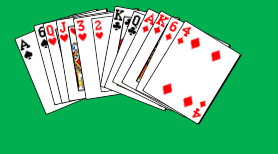
Everyone gets 13 cards, and your team tries to win more cards than the opposition.
Sort your hand into suits, alternating black and red.
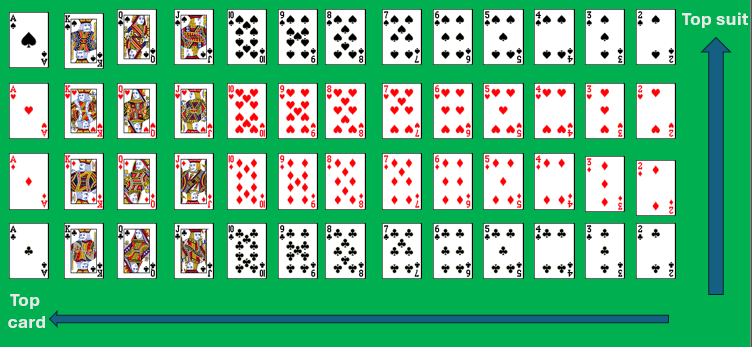
Cards run from Ace (the boss) down to Two (apprentice).
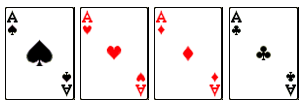
Suits have a pecking order:
♠ Spades are the boss.
♥ Hearts are management.
♦ Diamonds are the workers.
♣ Clubs make tea.
What's a Trick?
Everyone plays one card, going clockwise. Highest card wins.
Golden Rule: You must follow suit if you can.
If someone leads with a spade and you've got spades, you play a spade.
Only when you've run out can you play something else.
Watch winning a trick
Trumps
Before play begins, one suit gets crowned as 'trumps.' Trumps beat everything else.
Say hearts are trumps. Someone leads the ten of spades. You haven't got any spades left. Play even the tiniest heart - the two - you win.
Watch winning with a trump card
Feels like cheating the first time. It isn't. It's tactics.
Who gets to choose the trump suit? The person with the most points.
What are points? I'll show you now.
Counting Your Hand
Before anyone plays, everyone values their hand:
Each Ace is worth 4 points
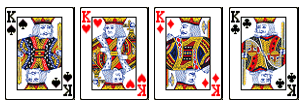
Each King is worth 3 points
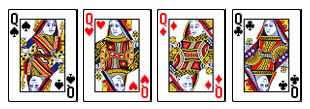
Each Queen is worth 2 points
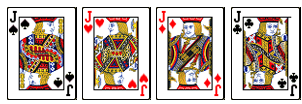
Each Jack is worth 1 point
The whole pack contains exactly 40 points. When everyone announces their totals, they should add up to 40.
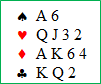
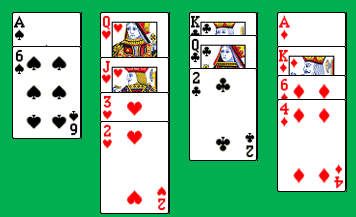
Bridge hands in books and online games are shown like this: